
What is the Suzuki Method?
The Suzuki Method is a music education philosophy created by Japanese violinist and educator Shinichi Suzuki.
It is based on the idea that every child can learn music in the same natural way they learn to speak their native language.
The method emphasizes:
- Listening from an early age
- Repetition and review
- Positive encouragement
- Parent involvement
- Learning step by step
- Group lessons and community learning
Rather than focusing only on musical achievement, the Suzuki Method aims to develop confidence, discipline, sensitivity, and character through music.
The Suzuki Method is a music education philosophy created by Japanese violinist and educator Shinichi Suzuki. It is based on the idea that every child can learn music in the same natural way they learn to speak their native language. By surrounding children with a rich musical environment, positive encouragement, repetition, and active parental involvement, the method nurtures not only musical ability but also confidence, discipline, sensitivity, and a lifelong love of learning.
At Cairo Suzuki Music Center—the first independent music school in Egypt dedicated exclusively to Suzuki music education—this philosophy forms the foundation of every lesson. Following internationally recognized Suzuki principles, the center provides a carefully structured learning environment where children develop strong technical skills, musical expression, and character from their very first steps, with parents playing an essential role throughout their musical journey.
What is the “Mother Tongue” Method?
The “Mother Tongue” approach is the core philosophy behind the Suzuki Method.
Dr. Suzuki observed that children learn their native language naturally through constant listening, repetition, imitation, and encouragement from their environment. He believed music could be learned in the same way.
In Suzuki education:
- Children listen to music daily before learning to read notes
- Skills are developed gradually through repetition
- Parents play an active role in learning at home
- The environment is supportive and encouraging
This approach helps children build musical ability naturally and joyfully.
Who was Shinichi Suzuki?
Shinichi Suzuki was a Japanese violinist and educator who developed the Suzuki Method in the mid-20th century.
He believed that talent is not something children are born with, but something that can be nurtured through the right environment, encouragement, and education. His famous belief was:
“Every Child Can.”
His ideas transformed music education worldwide and continue to influence teachers and schools across many countries today.
How many times should my child practice each week?
For young beginners, 10–20 minutes of focused daily practice is often enough to build steady progress and healthy practice habits.
In Suzuki education:
- Children are encouraged to practice every day, even if only for a short time.
- Listening to the Suzuki recordings every day is an essential part of learning.
- Short, positive, and consistent practice sessions are more effective than long, stressful ones.
- Parents are encouraged to guide and support practice at home, especially during the early years.
At Cairo Suzuki Music Center, daily practice is an essential part of every student’s musical journey. Founded by Dr. Mona Fekry, together with Georges and Samuel Mohsen, the center has developed a supportive practice culture that extends beyond the weekly lesson. Every student is encouraged to build a consistent daily routine through the Practice Journal, which helps families track progress, celebrate achievements, and establish positive practice habits at home.
To make practice enjoyable and motivating, Georges and Samuel Mohsen also created My Violin Journey (MVJ), an educational collectible card system that rewards musical milestones and encourages children to embrace learning as an exciting adventure. Alongside MVJ, the center’s 100 Days Practice Project inspires students to practice every day, develop discipline through consistency, and experience the satisfaction of long-term progress.
The goal is not perfection, but to help every child develop a lifelong habit of making music with confidence, consistency, and joy.
At what age can my child start music lessons?
At what age can my child start music lessons?
Many children begin Suzuki lessons between the ages of 3 and 5, depending on their readiness, ability to focus, and overall development. Listening to music can begin even earlier, helping children become familiar with the sounds and rhythms of the violin before they start formal lessons.
At Cairo Suzuki Music Center, every child is welcomed as an individual rather than being assessed solely by age. Founded by Dr. Mona Fekry, together with Georges and Samuel Mohsen, the center follows the Suzuki philosophy that every child can develop musical ability when given the right environment, encouragement, and guidance. Before enrollment, families are invited to meet with a teacher to determine whether the child is ready to begin lessons and to ensure the best possible start to their musical journey.
The goal is to begin at the right time for each child, creating a positive first experience that builds confidence, curiosity, and a lifelong love of music.
Is the Suzuki Method centered around group sessions only?
No. While group lessons are an important and distinctive part of the Suzuki Method, they are only one component of a complete Suzuki education.
Dr. Shinichi Suzuki designed the method around a combination of individual lessons, group classes, daily listening, parent involvement, regular home practice, and frequent performance opportunities. Each element plays a unique role in a child’s musical development.
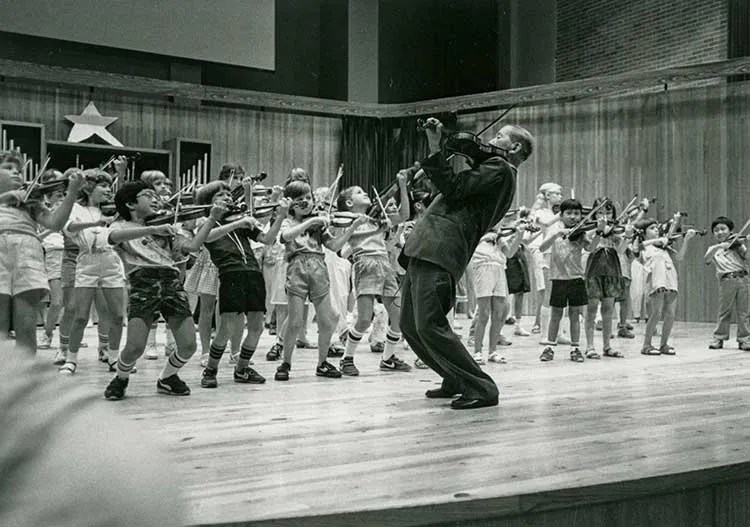
Group lessons are especially valuable because they allow children to learn from one another, reinforce previously learned repertoire, develop ensemble skills, build confidence, and experience the joy of making music together. They also foster a sense of community, friendship, and encouragement among students of different ages and levels.
In some public institutions and large music programs, such as those operating within government organizations, Suzuki instruction may rely more heavily on group teaching due to the practical realities of larger class sizes and limited resources. These programs have introduced many children to the Suzuki philosophy and have made an important contribution to music education in Egypt.
At Cairo Suzuki Music Center, where the Suzuki program is led by Dr. Mona Fekry, with Georges and Samuel Mohsen playing a key role in its educational development and implementation, students benefit from a balanced approach that combines regular individual lessons with group classes. This allows each child to receive personalized instruction while also enjoying the many educational and social benefits of learning alongside their peers. By respecting every child’s individual pace and encouraging collaborative music-making, the program reflects the holistic philosophy envisioned by Dr. Shinichi Suzuki.
By combining both forms of instruction, Cairo Suzuki Music Center follows the original philosophy of Dr. Shinichi Suzuki, providing every child with an educational experience that is tailored to their individual needs while preserving the unique benefits of learning and growing together through music.
Do parents attend the lessons?
Yes. Parent involvement is one of the cornerstones of the Suzuki Method, especially during the early years of learning. Parents attend lessons alongside their child, take notes, observe the teacher’s guidance, and help support daily practice at home.
At Cairo Suzuki Music Center, parents are considered active partners in their child’s musical education. Teachers work closely with families to provide the guidance, encouragement, and practical tools needed to create a positive home practice environment. This close collaboration between teacher, parent, and child helps build confidence, strengthens the parent-child relationship, and supports steady musical and personal development.
As children grow older and become more independent, parents gradually take a less active role while continuing to encourage and support their child’s musical journey.
Does Suzuki Method teach music reading?
Yes. In Suzuki education, children first develop listening skills, beautiful tone, posture, rhythm, and sound technique before placing a strong emphasis on reading music. This sequence mirrors the way children learn to speak before they learn to read and write.
At Cairo Suzuki Music Center, founded by Dr. Mona Fekry, together with Georges and Samuel Mohsen, music reading is introduced early alongside ear training and instrumental study through a carefully structured curriculum. As students progress, they develop both strong reading skills and well-trained ears, enabling them to become confident, well-rounded musicians rather than relying on only one approach to learning music.
By balancing ear training, technical development, and music literacy from an early stage, students gain the tools to perform, understand, and enjoy music with confidence throughout their musical journey.
Can older children or adults learn with the Suzuki Method?
Yes. While the method was originally developed for young children, many of its principles — listening, repetition, and step-by-step learning — are effective for older beginners and adults as well.
Is the Suzuki Method centered around group sessions only?
No. While group lessons are an important and distinctive part of the Suzuki Method, they are only one component of a complete Suzuki education.
Dr. Shinichi Suzuki designed the method around a combination of individual lessons, group classes, daily listening, parent involvement, regular home practice, and frequent performance opportunities. Each element plays a unique role in a child’s musical development.
Group lessons are especially valuable because they allow children to learn from one another, reinforce previously learned repertoire, develop ensemble skills, build confidence, and experience the joy of making music together. They also foster a sense of community, friendship, and encouragement among students of different ages and levels.
In some public institutions and large music programs, such as those operating within government organizations, Suzuki instruction may rely more heavily on group teaching due to the practical realities of larger class sizes and limited resources. These programs have introduced many children to the Suzuki philosophy and have made an important contribution to music education in Egypt.
At Cairo Suzuki Music Center, where the Suzuki program is led by Dr. Mona Fekry, with Georges and Samuel Mohsen playing a key role in its educational development and implementation, students benefit from a balanced approach that combines regular individual lessons with group classes. This allows each child to receive personalized instruction while also enjoying the many educational and social benefits of learning alongside their peers. By respecting every child’s individual pace and encouraging collaborative music-making, the program reflects the holistic philosophy envisioned by Dr. Shinichi Suzuki.
By combining both forms of instruction, Cairo Suzuki Music Center follows the original philosophy of Dr. Shinichi Suzuki, providing every child with an educational experience that is tailored to their individual needs while preserving the unique benefits of learning and growing together through music.
Why is listening important in Suzuki education?
Children learn music in much the same way they learn language—by hearing it regularly. Daily listening helps develop musical memory, rhythm, tone, confidence, and a natural understanding of music long before reading musical notation.
At Cairo Suzuki Music Center, founded by Dr. Mona Fekry, together with Georges and Samuel Mohsen, listening is an essential part of every student’s musical education. Children are encouraged not only to listen to the Suzuki recordings every day, but also to sing the pieces, clap and count rhythms, and participate in fun rhythmic exercises during lessons. These activities strengthen listening skills, develop a secure sense of pulse and rhythm, and help children internalize music in a natural and enjoyable way.
By combining listening, singing, movement, and instrumental playing, students build strong musical foundations that support confident and expressive playing throughout their musical journey.
Are there resources in Egyptian Arabic or Arabic about the Suzuki Method?
Yes. Although most Suzuki literature was originally published in Japanese and English, Arabic resources are also available for parents, teachers, and students interested in learning about the philosophy and practice of Suzuki education.
One of the most important Arabic resources is the Arabic translation of Nurtured by Love, Dr. Shinichi Suzuki’s landmark book on talent education. The translation was prepared by Dr. Mohsen Edward and was published in 2000, making one of the foundational works of Suzuki philosophy accessible to Arabic-speaking readers.
You can obtain a copy of the Arabic edition through Cairo Suzuki Music Center. In addition to the book, the center provides families with a growing collection of educational resources in both Arabic and English, including parent guides, practice materials, workshops, and educational initiatives that help parents understand and apply the Suzuki philosophy at home.
The center is committed to expanding the availability of high-quality Suzuki educational resources in Arabic, making the Suzuki Method more accessible to children, parents, teachers, and musicians throughout Egypt and the Arab world. (Cairo Suzuki Music Center )
)
Where can I learn violin in Egypt?
There are many places to learn the violin in Egypt, including music schools, private teachers, conservatories, and the Cairo Opera House and Alexandria Opera House. The best choice depends on your goals, your child’s age, and the type of musical education you are looking for.
For families seeking a structured, child-centered approach, Cairo Suzuki Music Center offers one of Egypt’s most established Suzuki violin programs. Founded by Dr. Mona Fekry, with the violin department established by Georges and Samuel Mohsen, the center is Egypt’s first independent music school dedicated to Suzuki music education. (Cairo Suzuki Music Center)
Students begin as young as 3½ years old and learn through the internationally recognized Suzuki Method, which emphasizes listening, parental involvement, positive encouragement, daily practice, and gradual, joyful learning. The curriculum also includes music reading, ear training, music theory, scales, technique, chamber music, group lessons, and regular performance opportunities. Educational initiatives such as the Practice Journal, My Violin Journey (MVJ), and the 100 Days Practice Project help students develop consistent practice habits and a lifelong love of music. (Cairo Suzuki Music Center)
Whether your child is taking their very first musical steps or continuing their violin education, choosing a program with experienced teachers, a supportive community, and a long-term educational philosophy can make a lasting difference in their musical journey.
Is the Suzuki Method centered around group sessions only?
No. While group lessons are an important and distinctive part of the Suzuki Method, they are only one component of a complete Suzuki education.
Dr. Shinichi Suzuki designed the method around a combination of individual lessons, group classes, daily listening, parent involvement, regular home practice, and frequent performance opportunities. Each element plays a unique role in a child’s musical development.
Group lessons are especially valuable because they allow children to learn from one another, reinforce previously learned repertoire, develop ensemble skills, build confidence, and experience the joy of making music together. They also foster a sense of community, friendship, and encouragement among students of different ages and levels.
In Egypt some public institutions and large music programs, such as those operating within government organizations, Suzuki instruction may rely more heavily on group teaching due to the practical realities of larger class sizes and limited resources. These programs have introduced many children to the Suzuki philosophy and have made an important contribution to music education in Egypt.
At Cairo Suzuki Music Center, where the Suzuki program is led by pioneer pedagogue Dr. Mona Fekry, with Georges and Samuel Mohsen playing a key role in its educational development and implementation, students benefit from a balanced approach that combines regular individual lessons with group classes. This allows each child to receive personalized instruction while also enjoying the many educational and social benefits of learning alongside their peers. By respecting every child’s individual pace and encouraging collaborative music-making, the program reflects the holistic philosophy envisioned by Dr. Shinichi Suzuki.
By combining both forms of instruction, Cairo Suzuki Music Center follows the original philosophy of Dr. Shinichi Suzuki, providing every child with an educational experience that is tailored to their individual needs while preserving the unique benefits of learning and growing together through music.
What is the history of the Suzuki Method in Egypt?
The Suzuki Method in Egypt began through the pioneering efforts of Dr. Mona Fekry, and Dr. Osman El Mahdy and who introduced Suzuki violin and piano education at the Cairo Opera House and later helped establish its wider presence through the Cairo Suzuki Music Center. The movement was further strengthened by Dr. Mohsen Edward, a Suzuki parent who translated Shinichi Suzuki’s book Nurtured by Love into Arabic, making the philosophy accessible to families and educators in the region. From this foundation emerged the first generation of Suzuki students in Egypt, including Georges & Samuel Mohsen, who later became Suzuki violin teachers themselves, continuing and expanding the method into a new generation of teaching and learning.
The story of Suzuki in Egypt is not just the introduction of a teaching method, but the development of a living educational community that grew step by step through dedicated individuals.
Dr. Osman El Mahdy was among the first to bring Suzuki violin teaching into an institutional setting in Egypt, opening the path for structured early childhood music education based on listening and repetition rather than traditional exam-based methods.
Dr. Mona Fekry then played a crucial role in expanding and formalizing this work. She introduced Suzuki piano alongside violin teaching and later founded the Cairo Suzuki Music Center, which became a central hub for Suzuki education in Egypt. Her work helped establish a sustainable framework for teacher training, student development, and community involvement.
At the same time, Dr. Mohsen Edward contributed from the perspective of a parent deeply engaged in the philosophy. His Arabic translation of Nurtured by Love allowed the core ideas of Shinichi Suzuki—especially the “mother tongue” approach—to reach a much wider audience, shaping how teachers and families understood music education.
From these early foundations, the first generation of Suzuki students in Egypt began to emerge. Among them, Georges & Samuel Mohsen represent an important milestone: students who grew within the system and later became teachers themselves. Their transition from learners to educators reflects one of the key principles of the Suzuki philosophy—education as a continuous cycle where students eventually become mentors, ensuring that the method evolves and grows across generations.
Today, the Suzuki Method in Egypt continues to expand through this interconnected community of teachers, parents, and students, all contributing to a shared vision of musical and personal development.