
More than 80 years ago, Japanese violinist Shinichi Suzuki realized the implications of the fact that children the world over learn to speak their native language with ease. He began to apply the basic principles of language acquisition to the learning of music, and called his method the mother-tongue approach. The ideas of parent responsibility, loving encouragement, constant repetition, etc., are some of the special features of the Suzuki approach.
Parent Involvement
As when a child learns to talk, parents are involved in the musical learning of their child. They attend lessons with the child and serve as “home teachers” during the week. One parent often learns to play before the child, so that s/he understands what the child is expected to do. Parents work with the teacher to create an enjoyable learning environment.
Early Beginning
The early years are crucial for developing mental processes and muscle coordination. Listening to music should begin at birth; formal training may begin at age three or four, but it is never too late to begin.
Listening
Children learn words after hearing them spoken hundreds of times by others. Listening to music every day is important, especially listening to pieces in the Suzuki repertoire so the child knows them immediately.
Repetition
Constant repetition is essential in learning to play an instrument. Children do not learn a word or piece of music and then discard it. They add it to their vocabulary or repertoire, gradually using it in new and more sophisticated ways.
Encouragement
As with language, the child’s effort to learn an instrument should be met with sincere praise and encouragement. Each child learns at his/her own rate, building on small steps so that each one can be mastered. Children are also encouraged to support each other’s efforts, fostering an attitude of generosity and cooperation.
Learning with Other Children
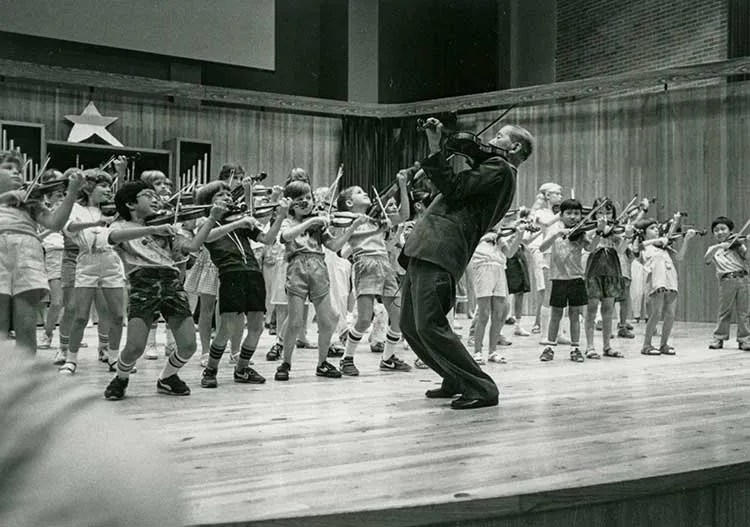
In addition to private lessons, children participate in regular group lessons and performance at which they learn from and are motivated by each other.
Graded Repertoire
Children do not practice exercises to learn to talk, but use language for its natural purpose of communication and self-expression. Pieces in the Suzuki repertoire are designed to present technical problems to be learned in the context of the music rather than through dry technical exercises.
Delayed Reading
Children learn to read after their ability to talk has been well established. in the same way, children should develop basic technical competence on their instruments before being taught to read music.
For more information on the Suzuki Method and how it help your child develop, please give us a call!
About the Cairo Suzuki Music Center
The Cairo Suzuki Music Center (CSMC) is one of Egypt’s leading institutions for piano lessons, violin lessons, and early childhood music education. Founded in 1997 by Dr. Mona Fekry, it is Egypt’s first independent institution to adopt the Suzuki Method outside the governmental programs of the Cairo Opera House and Alexandria Opera House. Since the establishment of its violin department in 2007 by violinists and Suzuki teachers Georges & Samuel Mohsen, the Center has continued to contribute to the development of music education in Egypt through teaching, educational resources, research, concerts, and community engagement.
Inspired by the educational philosophy of Dr. Shinichi Suzuki, the Center believes that every child can develop musical ability within a nurturing environment built on encouragement, careful guidance, consistent practice, and the active partnership between teachers and parents.
Offering piano and violin lessons in Cairo for children from the age of three, the Cairo Suzuki Music Center combines individual lessons, group classes, performances, workshops, and a carefully developed curriculum that blends the Suzuki repertoire with music theory, technical studies, chamber music, and a diverse range of classical and contemporary works. This balanced approach helps students build strong technical foundations while developing confidence, creativity, discipline, and a lifelong love of music.
Beyond the classroom, Georges & Samuel Mohsen have developed original educational resources—including the Violin Practice Journal and My Violin Journey (MVJ)—to encourage thoughtful practice, musical growth, and joyful learning for young violinists.
For nearly three decades, the Cairo Suzuki Music Center has welcomed families seeking piano lessons in Cairo, violin lessons in Cairo, and music education in Egypt, creating a supportive community where children learn, collaborate, overcome challenges, and discover the joy of making music together. Today, the Center continues to inspire new generations of young musicians through the enduring belief at the heart of the Suzuki Method: Every Child Can.

